

Overview of corrugated void fill
Corrugated void fill is a smart solution for companies looking to pack faster, reduce waste, and simultaneously improve their sustainability efforts. Instead of purchasing new filling material, used corrugated cardboard can be transformed into effective packaging void fill directly within the business. This allows the same material to have a longer life before being recycled again.
For many warehouses and e-commerce companies, this is a practical way to combine economic and environmental benefits. Cardboard boxes that would otherwise become waste can be converted into shock-absorbing and volume-creating material for new deliveries. The result is a more circular flow where packaging is better utilized, while the need for external purchases decreases.
ReppaP bases its solution on precisely this principle: that companies should be able to stop buying void fill material and produce it themselves. When cardboard waste is converted on-site, a sustainable packaging material is created that is locally produced, reused, and easy to recycle after use.
By reusing corrugated cardboard as void fill, waste becomes a resource instead of a cost
This approach is particularly well-suited for operations that ship fragile goods, varying order sizes, or large volumes daily. With the right structure in the material, corrugated cardboard can provide both protection and fill without complicating the packing process. Therefore, corrugated void fill has become an increasingly relevant choice for modern warehouses looking to pack smarter.
How corrugated cardboard becomes void fill directly in the warehouse
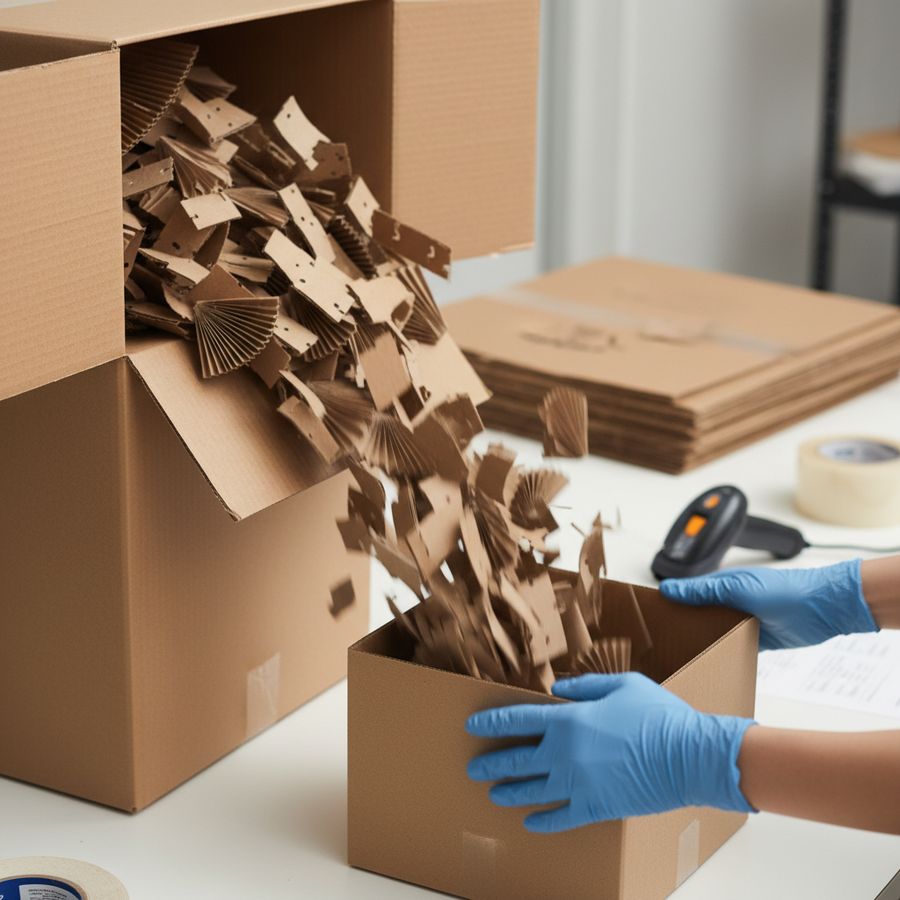
Converting used corrugated cardboard into void fill in the warehouse is easier than many imagine. With a cardboard shredder, used boxes are fed into the machine, which then processes the material into a shock-absorbing and filling structure. In this way, your own cardboard waste is transformed into new filling material exactly where it is needed.
The major advantage is that the process occurs without unnecessary transport or intermediate steps. Instead of first storing cardboard for recycling and then purchasing new packaging, the warehouse can create its own material on-site. This saves time, storage space, and purchasing costs. For businesses with high outbound delivery volumes, this quickly becomes a natural part of the packing line.
ReppaP's concept is based on converting discarded corrugated boxes into shock absorption for outbound shipments of fragile goods. This makes the solution particularly relevant for companies that already have a steady supply of cardboard in their inbound logistics. The material is also locally produced, which strengthens the company's efforts towards more sustainable packaging material.
-
Reduced need to purchase new void fill material
-
Quick access to void fill at the packing station
-
Better utilization of existing cardboard waste
-
Easier recycling for the recipient as well
When the material is produced directly in the warehouse, packing becomes more flexible. Staff can create the right amount of void fill when needed, instead of adapting to pre-purchased volumes and standard formats.
Three forms of void fill material from used cardboard
A great strength of corrugated void fill is that the same raw material can be transformed into several types of protection. According to ReppaP, used cardboard can become three different products for shock absorption: WELL-CHIPS, WELL-STRIPS, and WELL-NET. This makes the solution useful for different products, box sizes, and packing needs.
WELL-CHIPS are suitable when you need loose void fill that quickly fills empty spaces in a box. This works well for products that need to be stabilized from multiple sides. WELL-STRIPS, on the other hand, are practical when you want to build volume, separate products, or create a simple shock-absorbing layer around items. WELL-NET provides a more cohesive structure that can contribute to both protection and flexibility around sensitive products.
By choosing the right form of void fill, packing can be adapted to the weight, shape, and fragility of the goods. This means that reused corrugated cardboard works in more situations than many initially assume.
-
WELL-CHIPS for quick void filling
-
WELL-STRIPS for volume and separation
-
WELL-NET for enveloping and shock-absorbing protection
Three structures from the same cardboard material provide greater flexibility in packing without the need to purchase new resources
It is precisely this variation that makes corrugated cardboard a versatile and sustainable packaging material. Companies can use their own cardboard flow to create the type of filling material that best suits their daily operations.
Faster packing with the right volume and structure
To pack efficiently, it's not enough to just fill a box. The material must also have the right volume, resilience, and structure to protect the product without slowing down the workflow. Here, corrugated cardboard becomes particularly interesting, as it can provide both shock absorption and quick handling in the same step.
When void fill is produced directly from cardboard in the warehouse, it becomes easier to adapt the quantity to each shipment. Staff do not need to search for different types of purchased packaging or try to use too much or too little material. Instead, a smoother process is created where the right amount of fill is readily available at the packing station.
This often leads to faster packing in practice, especially when order patterns vary. Small products require less volume, while larger or more fragile shipments may need more enveloping protection. With processed corrugated cardboard, both needs can be met without changing systems or material type.
The right void fill material also reduces the risk of repacking, damage, and unnecessary time consumption. When goods are stable from the start, the workday becomes smoother for packing staff and the experience better for the customer receiving the delivery.
In a modern warehouse, speed is therefore not just about pace, but about using a sustainable packaging material that performs consistently. Here, corrugated void fill can become an important part of a more efficient and well-thought-out packing flow.
When corrugated void fill reduces purchasing needs
Many companies initially view packaging as a pure consumable cost. But when used corrugated cardboard becomes new filling material, the calculation changes. Instead of continuously purchasing plastic-based or paper-based packaging void fill, the business can use a resource that already exists in daily operations.
This is particularly valuable for warehouses, wholesalers, and e-commerce businesses that receive large quantities of goods in cardboard boxes. The more cardboard that comes in, the greater the opportunity to create your own corrugated void fill. In this way, purchasing needs can significantly decrease over time, while waste management becomes more resource-efficient.
In addition to lower material costs, there are also other savings to consider. Fewer deliveries of new packaging mean less transport, less storage requirements, and better control over the availability of packing materials. The company simply becomes less vulnerable to price changes and delivery disruptions.
-
Lower ongoing costs for purchased void fill material
-
Less dependence on external suppliers
-
Better utilization of existing cardboard waste
-
Stronger profile in circular and sustainable working methods
When the company uses its own cardboard as void fill, packaging costs become more controllable and sustainable
For many, the biggest gain is the combination of economy and environment. A material that previously cost money to handle as waste instead becomes a sustainable packaging material with direct benefits in the business.
Conclusion on corrugated cardboard as sustainable void fill material
Corrugated cardboard is more than just ordinary packaging from incoming deliveries. When reused as void fill, it becomes a practical resource that helps companies pack faster, protect products better, and work more circularly. This makes corrugated void fill a relevant choice for businesses looking to combine efficiency with responsibility.
A key strength is that the material is already readily available. Companies do not need to wait for new deliveries of fill or tie up capital in large stocks of purchased packaging. Instead, their own cardboard flow can be used to create the right type of filling material as needed. This provides a solution that is both flexible and cost-conscious.
From a sustainability perspective, the advantages are clear. Reused corrugated cardboard contributes to less waste, fewer transports, and easier recycling for the recipient as well. When the material's lifespan is extended, the need for new resources decreases, making it a strong alternative for companies seeking a more sustainable packaging material.
In summary, developments show that smart packing is not just about protecting goods. It is also about choosing solutions that strengthen the entire logistics chain. With the right equipment and a well-thought-out approach, corrugated cardboard can become a long-term valuable part of a faster, simpler, and more sustainable packing flow.
0 comments