

Overview
Recycled cardboard has become a central component in the development of a sustainable and circular economy. By giving cardboard a second life, businesses and consumers contribute to reducing waste, saving resources, and lowering greenhouse gas emissions. In this article, we explore how recycled cardboard plays a vital role in the circular economy, with a particular focus on WELL-CHIPs – an innovative product that combines environmental benefits with social sustainability.
We will begin by explaining what a circular economy means in relation to packaging, and then delve into the role of recycled cardboard as a material in this context. WELL-CHIPs from ReppaP® are used as a clear example of how recycled cardboard can contribute to both environmental and economic benefits, while also creating social value through inclusive production. Finally, we will discuss the positive environmental impacts and economic advantages that come with choosing recycled cardboard as packaging filler.
Throughout the text, we will highlight why recycled cardboard is a smart and sustainable solution that helps companies act more environmentally conscious and contribute to a truly circular economy.
Circular economy and packaging
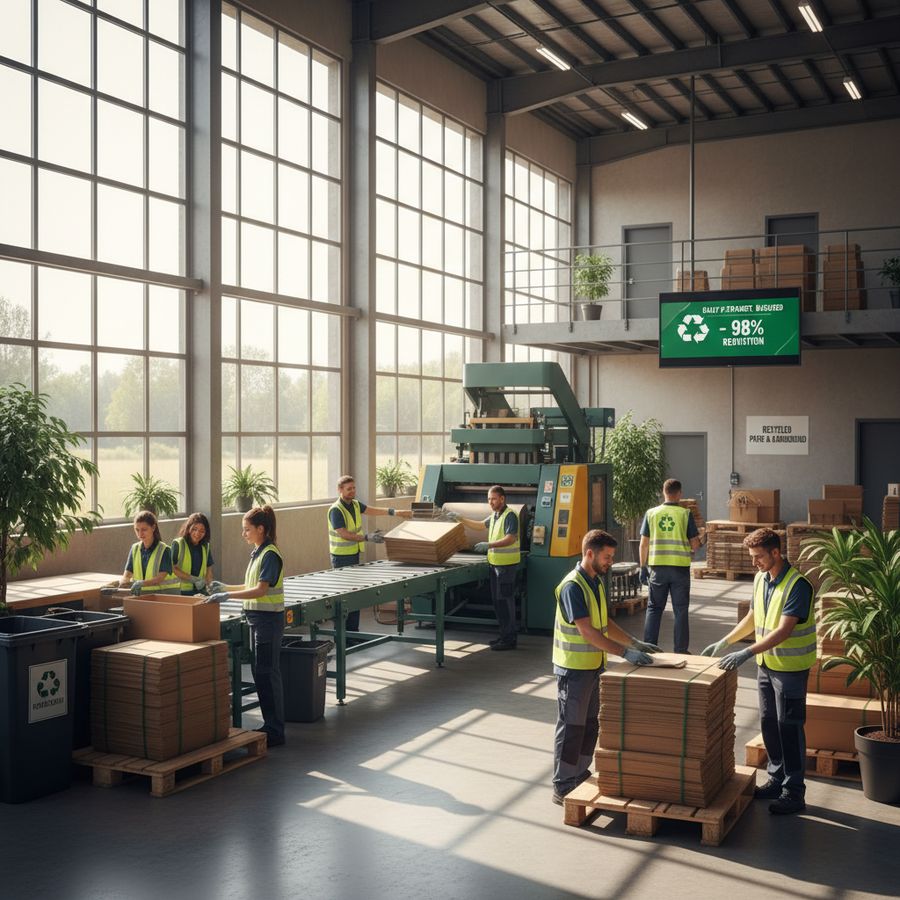
Circular economy is a model that aims to minimize waste and maximize resource reuse throughout a product's life cycle. In the packaging industry, this involves designing, producing, and using materials that can be recycled or reused instead of ending up as waste after a single use.
Traditional packaging materials such as plastic and newly produced cardboard often have a significant environmental impact, not least through high energy consumption and carbon dioxide emissions. By instead using recycled materials, a closed loop is created where raw materials circulate longer, which drastically reduces the need for new production and thus the burden on nature.
Packaging in a circular economy should therefore be designed to:
- Facilitate recycling and reuse.
- Reduce the use of new raw materials.
- Have low environmental impact during production and transport.
- Contribute to reduced greenhouse gas emissions.
Recycled cardboard fits perfectly into this model as it can be reused multiple times, has low energy consumption in production, and is fully recyclable after use. This makes it an ideal material for companies that want to optimize their packaging strategy from a sustainability perspective.
Role of recycled cardboard
Recycled cardboard plays a crucial role in the circular economy thanks to its ability to give old cardboard materials new life. Instead of being discarded after the first use, the cardboard is collected, processed, and reshaped into new products, such as packaging filler material. This reduces both waste volumes and the need for new raw materials.
The biggest advantage of recycled cardboard is its low carbon footprint. The production of new cardboard products requires energy and resources that often generate significant CO₂ emissions. By using existing material, these emissions can be almost entirely eliminated, making recycled cardboard an environmentally smart choice.
Recycled cardboard also offers the following advantages:
- Preserves natural resources such as trees and water.
- Reduces the burden on waste management systems.
- Contributes to more efficient resource utilization in society.
- Can be easily recycled after use, closing the material loop.
By integrating recycled cardboard into packaging solutions, companies can not only improve their environmental profile but also offer their customers sustainable alternatives that meet increasing demands for environmental awareness.
Well-chip:s as an example
WELL-CHIPs are a concrete example of how recycled cardboard can be used as a sustainable and efficient packaging filler. The product is made from recycled cardboard and has almost 0 CO₂ emissions in its production process, making it one of the market's most environmentally friendly filler solutions.
This packaging filler is not only environmentally smart but also socially sustainable. Production takes place in Sweden and involves people who are far from the labor market, such as individuals with diagnoses or functional variations. This makes WELL-CHIPs a product that combines environmental benefits with social responsibility.
WELL-CHIPs features include:
- 100% recyclable material and 94% recycled paper in the standard filling.
- Up to 30% lower CO₂ emissions compared to plastic-based alternatives.
- Daily deliveries across Sweden with a price guarantee for bulk purchases.
- Easy for the end customer to sort and recycle.
"With ReppaP® we save both money and CO₂ - and customers love it." – Warehouse Manager, E-commerce
Through WELL-CHIPs, ReppaP® demonstrates how recycled cardboard can be a practical, environmentally friendly, and economically advantageous solution for companies that want to contribute to a circular economy.
Environmental impacts
The environmental impacts of using recycled cardboard are significant and positive. The biggest gain lies in the reduction of carbon dioxide emissions, as recycling eliminates the need to produce new paper, which is an energy-intensive process. WELL-CHIPs, for example, show up to 30% lower CO₂ emissions compared to traditional plastic fillers.
Recycled cardboard also contributes to reduced waste in nature and landfills, as the material can be easily recycled or reused repeatedly. The short transportation distance during manufacturing in Sweden further reduces emissions and strengthens the local economy.
Other important environmental effects include:
- Preservation of forests and biodiversity through reduced need for new wood raw material.
- Reduced water consumption in the production chain compared to newly produced packaging.
- Lower energy consumption throughout the product's life cycle.
By choosing packaging materials such as WELL-CHIPs, companies can significantly reduce their climate impact and contribute to achieving global sustainability goals.
Economic benefits
Investing in recycled cardboard as packaging material also brings several economic benefits for companies. Firstly, costs for materials and waste management can decrease, as recycled products are often cheaper than newly produced alternatives. WELL-CHIPs also offer a price guarantee for larger volumes, which creates security and predictability in purchasing.
Efficient logistics, with daily deliveries and production close to the customer, contributes to lower transportation costs and shorter lead times. This is particularly important for e-commerce companies and retail that require reliable and sustainable packaging solutions.
Further economic benefits include:
- Improved environmental profile that strengthens the brand and can attract environmentally conscious customers.
- Reduced costs for waste management and recycling.
- Support for social sustainability, which can provide tax and CSR-related benefits.
- Increased customer satisfaction through products that are easy to sort and recycle.
In summary, recycled cardboard leads to both direct cost savings and long-term business advantages in an increasingly sustainable and circular economy.
Conclusion
Recycled cardboard is a key factor in developing and promoting a circular economy within the packaging industry. Through products like WELL-CHIPs, companies can easily reduce their climate impact, save money, and simultaneously take social responsibility.
The low environmental impact, combined with economic and social benefits, makes recycled cardboard a smart choice for companies that want to act sustainably and with a forward-looking approach. With a product like WELL-CHIPs, one also gets a local, secure, and credible solution that contributes to a greener and more inclusive labor market.
"It's business value with heart."
By integrating recycled cardboard into their operations, companies not only contribute to a circular economy but also to a more sustainable society as a whole. Choosing recycled cardboard is therefore an investment in the environment, the economy, and people. For more information, visit ReppaP.
0 comments